 4
4
 0
0
Read Time5 Minute, 36 Second
AWS networking is a foundational skill for modern cloud developers, yet it is often treated as an infrastructure concern rather than a core development competency. As applications become more distributed, globally accessible, and security-sensitive, understanding how AWS networking works is no longer optional, it is essential.
The “AWS Networking for Developers” series was created to provide a clear, practical, and developer-focused guide to AWS networking concepts. Instead of approaching networking from a purely theoretical or operations-centric perspective, this series explains how AWS networking services impact application design, performance, availability, security, and scalability.
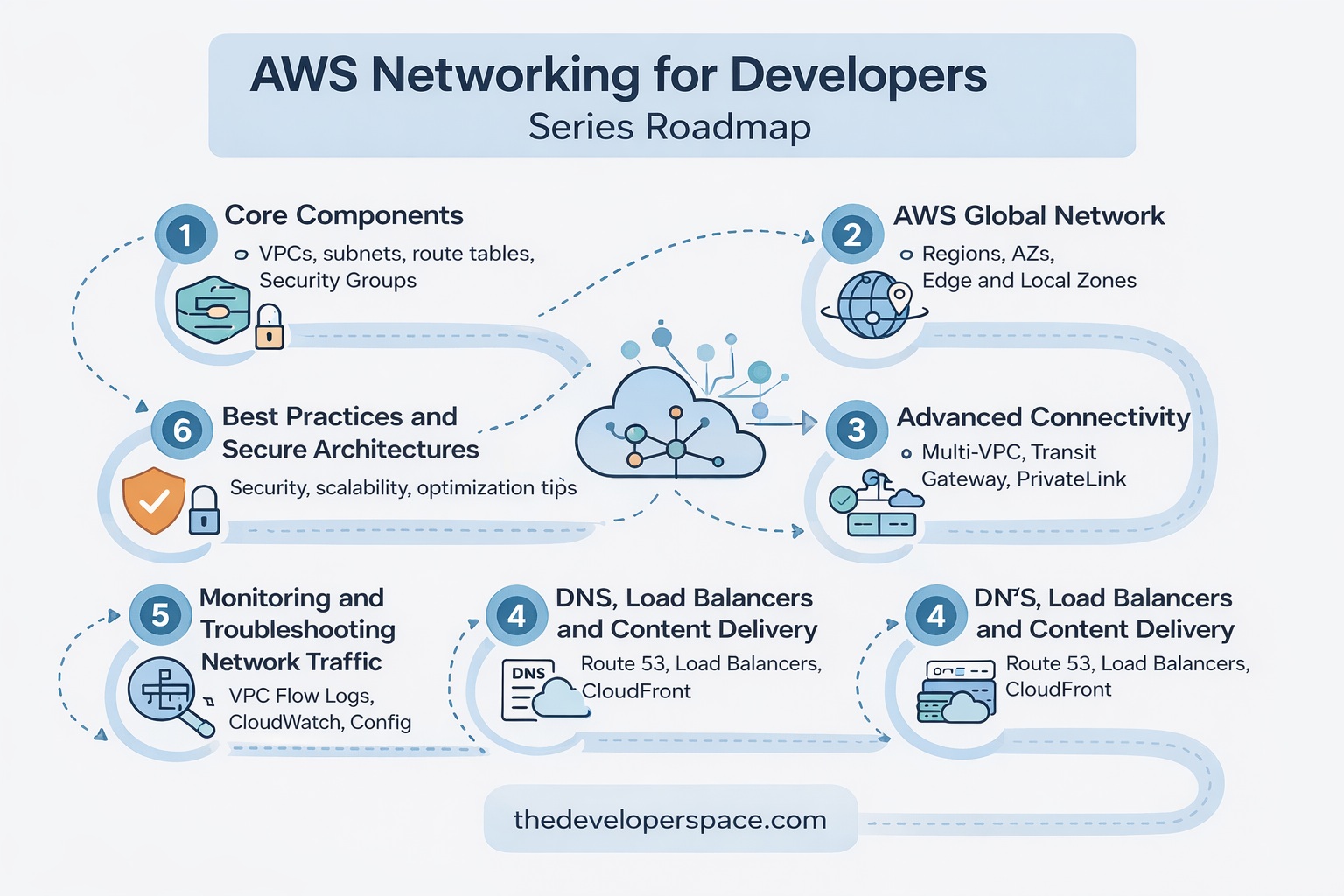
From VPC fundamentals and global infrastructure to advanced connectivity, DNS, load balancing, monitoring, and real-world best practices, this collection of articles equips developers with the knowledge required to design and operate production-grade systems on AWS. This page serves as the central guide to the complete series, with summaries and direct links to each part for easy navigation.
Contents
Part 1 – Core Components
🔗 https://thedeveloperspace.com/aws-networking-core-components/
This article lays the foundation by introducing the core building blocks of AWS networking. It explains how VPCs, subnets, route tables, Internet Gateways, NAT Gateways, and security boundaries such as Security Groups and NACLs work together.
The focus is on helping developers understand how traffic actually flows inside a VPC, rather than memorizing definitions. By the end of this part, readers gain a clear mental model of how AWS networks are structured and how applications connect to internal and external services.
Part 2 – AWS Global Network
🔗 https://thedeveloperspace.com/aws-global-network/
Part 2 zooms out to AWS’s global infrastructure and explains Regions, Availability Zones, Edge Locations, Local Zones, and Wavelength Zones from a developer’s perspective.
This article answers critical design questions such as:
- Why region selection matters for latency and compliance
- How Availability Zones impact high availability
- When Edge Locations, Local Zones, and Wavelength Zones are relevant
It helps developers make informed architectural decisions instead of treating global infrastructure as an afterthought.
Part 3 – Advanced Connectivity
🔗 https://thedeveloperspace.com/aws-advanced-connectivity/
This article dives into advanced networking patterns used in real-world AWS environments. It covers services such as:
- VPC Peering
- AWS Transit Gateway
- AWS PrivateLink
- VPC Endpoints (Gateway and Interface)
Each concept is explained through practical developer use cases, showing when and why you would choose one approach over another. This part is especially useful for developers working with multi-VPC, multi-account, or enterprise-scale architectures.
Part 4 – DNS, Load Balancers, and Content Delivery
🔗 https://thedeveloperspace.com/aws-networking-dns-lb-cdn/
Part 4 focuses on how users reach your applications. It covers:
- Amazon Route 53 and DNS routing strategies
- Application, Network, and Gateway Load Balancers
- Amazon CloudFront and content delivery concepts
The article connects DNS, load balancing, and CDN behavior into a single flow, helping developers understand how traffic is routed, distributed, and optimized globally for performance and resilience.
Part 5 – Monitoring and Troubleshooting Tools
🔗 https://thedeveloperspace.com/monitoring-and-troubleshooting-aws-network-traffic/
This part addresses one of the most common pain points: diagnosing network issues in AWS.
It introduces tools such as:
- VPC Flow Logs
- AWS CloudWatch
- AWS Config
- Reachability Analyzer
The emphasis is on how developers can observe, debug, and validate network behavior, rather than relying on guesswork. This article helps bridge the gap between network design and operational reality.
Part 6 – Developer Best Practices
🔗 https://thedeveloperspace.com/aws-networking-developer-best-practices/
The final article consolidates the entire series into actionable best practices. It covers:
- Secure VPC and subnet design
- High availability and fault tolerance strategies
- Least-privilege networking and segmentation
- Scalability and future-proofing patterns
This part serves as both a capstone and a checklist for developers designing or reviewing AWS-based systems.
How to Use This Series
- New to AWS networking? Start from Part 1 and read sequentially.
- Designing a production system? Focus on Parts 2, 3, and 6.
- Troubleshooting issues? Jump directly to Part 5.
- Optimizing performance and availability? Parts 4 and 6 are key.
Together, these articles form a complete, developer-oriented guide to AWS networking, balancing conceptual clarity with real-world applicability.
Conclusion
AWS networking is not a single service or feature, it is a system of interconnected components that directly influences how applications behave in production. Developers who understand these components are better equipped to build architectures that are secure, resilient, cost-effective, and scalable from day one.
The “AWS Networking for Developers” series brings together all the critical networking concepts developers need, presented in a logical progression from fundamentals to advanced design patterns and operational best practices. Whether you are learning AWS networking for the first time, preparing for architectural discussions, or refining existing systems, these articles are designed to serve as a long-term reference.
By mastering AWS networking concepts, not just at a service level, but at a design level, you gain greater control over application performance, reliability, and security. This series is intended to help developers move beyond “it works” architectures toward well-designed, production-ready cloud systems.